


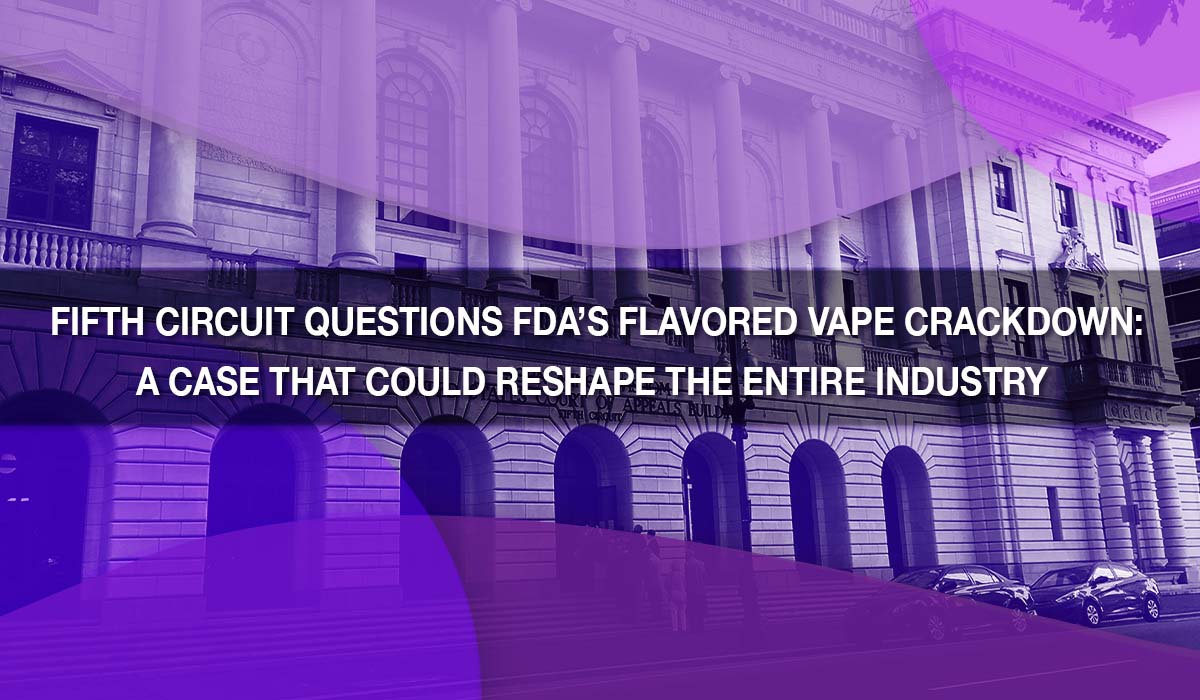
Fifth Circuit Questions FDA’s Flavored Vape Crackdown: A Case That Could Reshape the Entire Industry
A major federal court battle is unfolding that could impact thousands of vape product applications and determine whether the FDA overstepped its authority when denying flavored vapor products.
This week, the U.S. Court of Appeals for the Fifth Circuit heard arguments in a consolidated appeal involving seven independent vape companies challenging the FDA’s sweeping denial of flavored e-liquid applications.
At the center of the dispute is a simple but critical question:
Can the FDA require manufacturers to meet standards it never clearly announced in advance?
For adult consumers, small businesses, and manufacturers across the country, the answer could be enormous.
What the Case Is About
After the 2020 PMTA deadline, manufacturers submitted applications under the Tobacco Control Act seeking authorization to continue selling products legally.
Many small companies spent years and millions of dollars preparing applications that included:
- Toxicology data
- Scientific studies
- Consumer behavior surveys
- Youth access prevention plans
- Manufacturing details
- Marketing restrictions
But when many flavored products were reviewed, the FDA issued Marketing Denial Orders (MDOs) claiming companies failed to provide something called comparative efficacy evidence—proof that flavored products help smokers switch better than tobacco-flavored products.
The problem?
Many applicants argue the FDA never clearly told them that would be required before submissions were due.
Why the Fifth Circuit Matters
During oral arguments, judges appeared focused on whether the FDA effectively created a new rule without going through the legally required notice-and-comment rulemaking process under the Administrative Procedure Act.
That matters because federal agencies cannot simply invent new industry-wide standards behind closed doors and apply them retroactively.
If the court agrees, it could mean the FDA improperly denied thousands of applications using an unlawful standard.
The FDA’s Position
The government argued that the Tobacco Control Act places the burden on manufacturers to prove their products are “appropriate for the protection of public health.”
FDA lawyers claimed:
- Flavored vapor products create greater youth appeal risks
- Tobacco-flavored products may provide similar adult switching benefits
- Each product must prove its own public-health benefit individually
That sounds straightforward on paper.
But critics say in practice it became a de facto ban on nearly all independent flavored vapor products.
Why This Matters for Adult Smokers
Millions of adults did not quit smoking with tobacco-flavored products alone.
They switched using:
- Fruit flavors
- Dessert flavors
- Mint varieties
- Beverage-inspired flavors
- Menthol products
- Open-system refillable devices paired with flavored e-liquids

Ignoring that real-world behavior while demanding impossible or undefined studies creates a market where only the largest corporations can survive.
Small Businesses vs. Corporate Giants
This case also highlights a broader problem with the PMTA process:
Large tobacco-owned brands often have the money, legal teams, and scientific resources to navigate the FDA maze.
Independent American companies frequently do not.
When regulatory standards are vague, expensive, and constantly shifting, small businesses lose first.
Consumers lose second.
Big Tobacco wins last.
What Happens Next
A ruling from the Fifth Circuit could:
- Reopen denied flavored applications
- Limit FDA’s ability to use hidden standards
- Clarify PMTA review requirements
- Impact thousands of pending applications
- Reshape the future of vapor regulation nationwide
The Bigger Picture
This case is about more than flavored vape products.
It is about whether federal agencies must follow the law, give fair notice, and regulate transparently.
If the FDA can change the rules after applications are filed, no small business in America is truly operating on stable ground.
And if safer alternatives are blocked while cigarettes remain widely available, policymakers should explain how that serves public health.
Flavored Vapor Products are Not Available for purchase in the state of California


Leave a comment
This site is protected by hCaptcha and the hCaptcha Privacy Policy and Terms of Service apply.